 Save
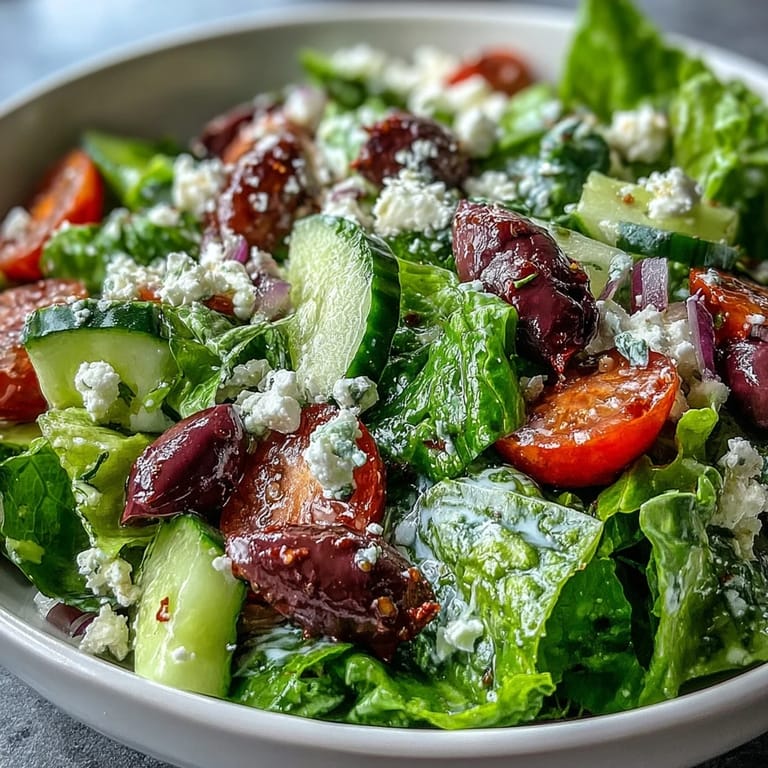
Save There's something about a Greek salad that transports you instantly—one bite and suddenly you're sitting at a sun-dappled taverna table, the Aegean breeze ruffling napkins, even if you're really just in your kitchen on a Tuesday. I discovered this particular version years ago when a friend casually tossed one together while we talked, and I realized how the simplicity was actually the whole point: good ingredients need barely any fussing. It's become my go-to when I want something that feels both indulgent and impossibly light.
I made this for my neighbor last summer when she was recovering from surgery and tired of the heavy casseroles everyone kept bringing over. She took one bite and actually smiled—properly smiled—for the first time in days. That taught me something about how the right food at the right moment isn't about complexity; it's about understanding what someone's body actually wants.
Ingredients
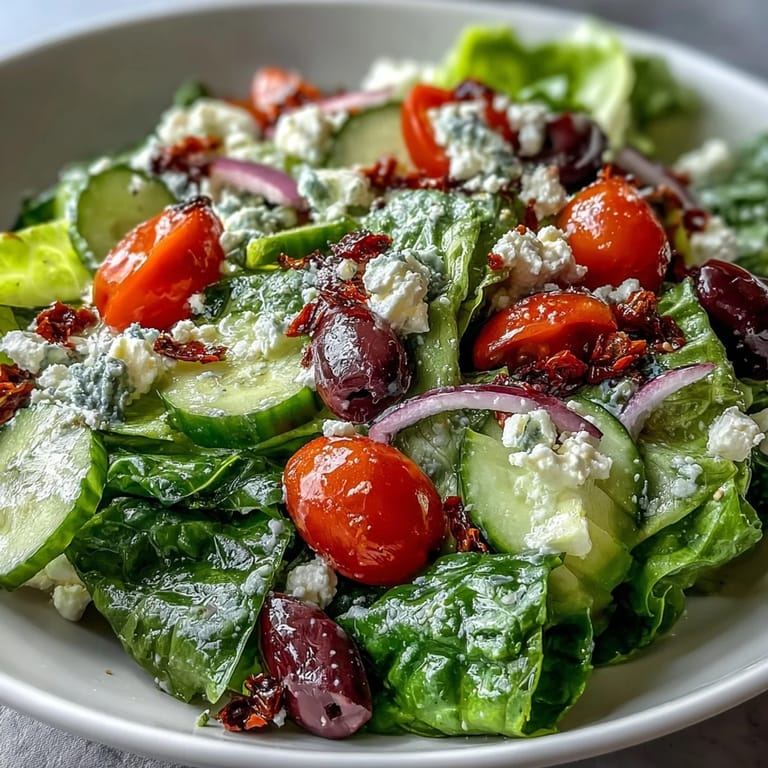
- Romaine lettuce: Use the inner leaves if you can; they're tender without being wimpy, and they hold the dressing better than the outer ones.
- Cherry tomatoes: Halve them so the cut sides catch the vinaigrette and release their juices into the bowl.
- Cucumber: Slice it on a slight bias to create more surface area and because it looks intentional.
- Red onion: Slice it thin enough to see light through it; this way it seasons the salad rather than dominating it.
- Feta cheese: Crumble it by hand rather than cutting it into cubes—the irregular pieces distribute through the salad more generously.
- Kalamata olives: These are briny and assertive; if you find them too strong, you can swap in green olives for something milder.
- Extra-virgin olive oil: This is where quality matters because it's doing the heavy lifting in the dressing—don't skimp or substitute.
- Red wine vinegar: The backbone of the vinaigrette; it cuts through the richness of the feta and makes everything taste more alive.
- Dried oregano: Mediterranean oregano if you can find it—it carries the whole flavor profile and reminds you why this salad works.
- Garlic: Mince it fine so it distributes evenly without creating sharp pockets in any single bite.
- Dijon mustard: Just a tiny bit acts like an emulsifier and adds complexity you can't quite name but definitely notice.
Tired of Takeout? 🥡
Get 10 meals you can make faster than delivery arrives. Seriously.
One email. No spam. Unsubscribe anytime.
Instructions
- Gather your vegetables:
- Chop the romaine, halve the tomatoes, slice the cucumber, and thinly shave the red onion. Do this while you're thinking about something else if you want—there's no precision drama here, just good knife work and whatever rhythm you fall into.
- Build the salad bowl:
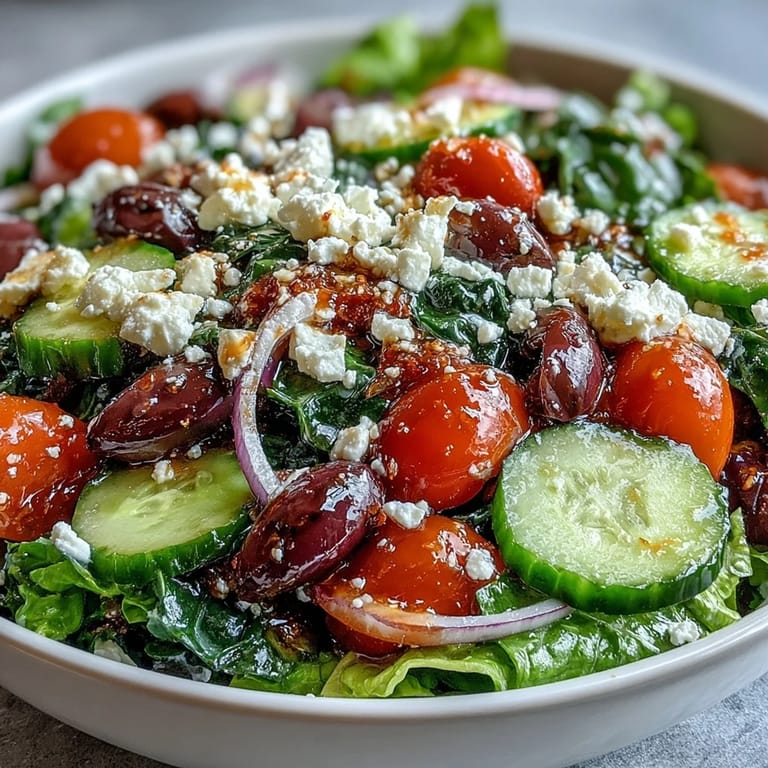
- Toss the lettuce, tomatoes, cucumber, and onion together in your largest bowl, then scatter the crumbled feta and halved olives across the top. You're not fully mixing yet; just creating layers of flavor that are about to become one.
- Make the vinaigrette:
- In a small bowl or jar, combine the olive oil, red wine vinegar, oregano, minced garlic, Dijon mustard, salt, and pepper. Whisk it hard until it looks slightly cloudy and emulsified; you'll notice the oil and vinegar are actually getting along now instead of trying to separate.
- Dress at the last moment:
- Drizzle the vinaigrette over the salad just before serving—if you do it too early, the lettuce starts to wilt and the tomatoes release too much liquid. Toss gently with two large spoons, turning the salad over itself until everything's coated.
- Serve right away:
- Plate it immediately while there's still a cool crunch to everything and the flavors haven't started to blur together.
 Save
Save My kids actually ask for this salad now, which still surprises me every single time. They fight over the olives and declare the feta "salty and perfect," and somehow that matters more than any restaurant version I've ever ordered.
The Beauty of Simplicity
This salad proves that you don't need a dozen techniques or obscure ingredients to make something memorable. The magic is in respecting each component enough to let it be itself—crisp lettuce is crisp lettuce, feta is feta, and when they meet with good olive oil and vinegar, something genuinely delicious happens. I've learned that restraint in the kitchen is sometimes the hardest skill to master, mostly because we're all conditioned to believe more is better.
Making It Your Own
This is one of those recipes that welcomes improvisation without breaking. Bell peppers add crunch and sweetness if you want that. Fresh dill scattered over the top brings an unexpected brightness. Grilled chicken or chickpeas turn it into something that can anchor a meal instead of accompanying one. I've even made it with roasted beets once, and while that's admittedly stepping into a different direction, nobody complained.
When You Taste It
The first bite should make you pause for a second—the combination of creamy feta, briny olives, bright vinegar, and crisp vegetables all hitting at once. It's the kind of salad that tastes like an entire memory, not just lunch. Pay attention to how the oregano comes through at the end, how the garlic whispers rather than shouts, how your palate feels clean and ready for whatever comes next.
- Keep your bowls and utensils chilled if you're making this in summer and want maximum crispness.
- If your feta is especially salty, you might want to reduce the salt in the vinaigrette slightly.
- This salad is best eaten within an hour of assembly, but the vinaigrette will keep in a jar in your fridge for up to five days.
 Save
Save This Greek salad has become one of those dishes I return to when everything feels complicated, because it reminds me that good food doesn't have to be fussy to be genuinely satisfying. Make it whenever you need something that tastes like care.
Recipe FAQs
- → Can I make Greek salad ahead of time?
Yes, you can prepare the vegetables and dressing separately up to 24 hours in advance. Store chopped vegetables in an airtight container and keep the vinaigrette in a sealed jar. Toss everything together just before serving to maintain the crisp texture and prevent sogginess.
- → What vegetables work best in Greek salad?
Traditional Greek salad features crisp cucumbers, ripe tomatoes, and red onions. You can also add bell peppers for extra crunch or fresh herbs like parsley and dill. Avoid watery vegetables that might dilute the dressing, and stick to firm, crisp varieties that hold up well when tossed.
- → How do I store leftover Greek salad?
Store undressed salad in an airtight container in the refrigerator for 2-3 days. Keep the dressing separately to prevent the vegetables from becoming wilted. If you've already dressed the salad, it's best enjoyed within 24 hours as the salt in the feta and olives will draw moisture from the vegetables.
- → Can I substitute the feta cheese?
For dairy-free options, try vegan feta alternatives made from almonds or tofu. Goat cheese or cotija can provide similar crumbly texture and tangy flavor. If avoiding cheese entirely, add extra olives and a sprinkle of nutritional yeast for savory depth while maintaining the Mediterranean profile.
- → What's the best way to cut vegetables for Greek salad?
Cut cucumbers into half-moon slices for easy eating. Halve cherry tomatoes or quarter larger tomatoes into bite-sized pieces. Slice red onions as thinly as possible for a milder bite. Chop romaine into manageable pieces that fit easily on a fork. Uniform sizing ensures even distribution of flavors.